Why Artists Keep Process Work: The Role of Studies and Working Notes
Why artists keep process work becomes clear when studies and notes preserve the choices behind a piece, making it easier to revisit without judging it as unfinished.
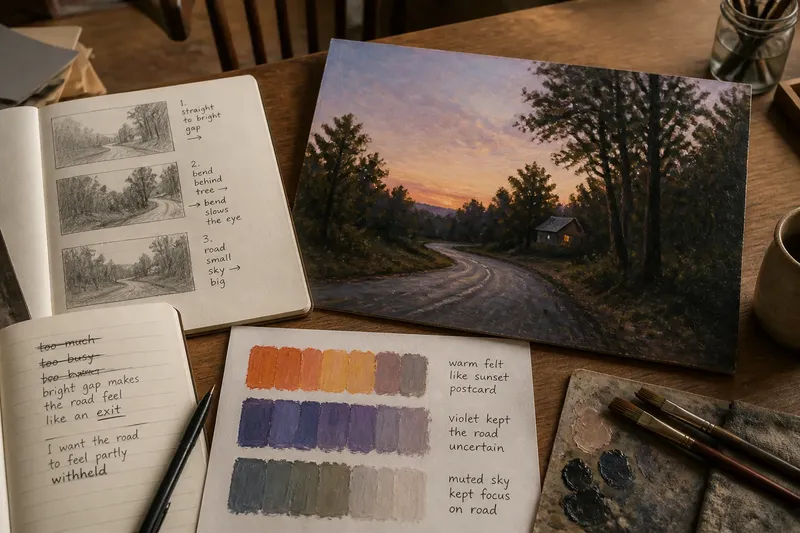
At the edge of a dining table, a painter sets a finished landscape beside a folded sheet of color tests and a notebook with a sentence crossed out twice. The finished piece shows a quiet road at dusk; the scraps record the choices that made the road feel quiet rather than empty. That is why artists keep process work: studies and working notes preserve decisions and alternatives that a final piece cannot always show.
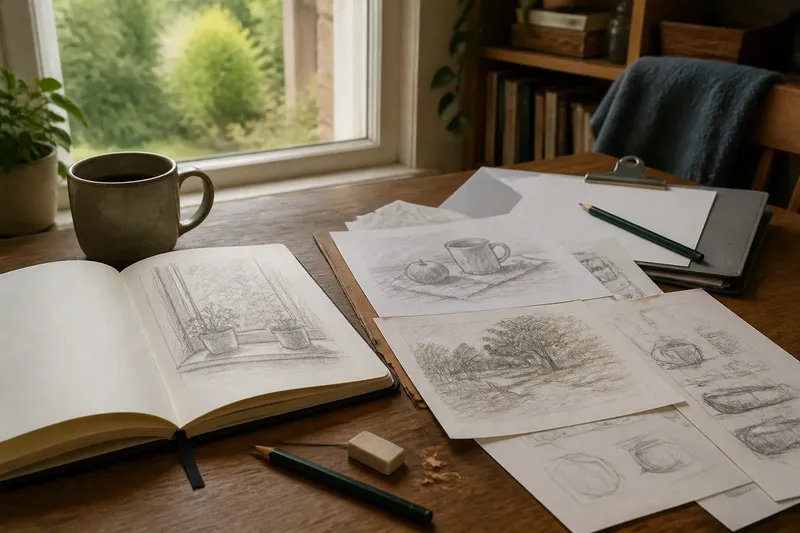
Process work is material made along the way: sketches, color trials, thumbnails, written observations, material samples, or notes about a change in direction. It does not need to be a polished preview of the final work. Its value lies in what it lets the artist notice later, including an option that was considered and set aside.
Imagine a landscape taking an unexpected turn
Imagine Mara, an invented painter, beginning a small landscape after a walk along a wooded road. She wants the painting to hold the feeling of returning home at dusk, but she has not decided whether the road should lead clearly toward a house or disappear among the trees. She starts with three quick pencil studies in a sketchbook, each testing a different placement for the road.
In the first, the road runs straight to a bright gap. In the second, it bends behind a tree. In the third, it occupies very little space and leaves the sky dominant. Mara marks a small arrow beside the second study and writes, “bend slows the eye.” The note does not claim that the second arrangement is best for every landscape; it records what she noticed in this one.
She then mixes a few small color patches on scrap paper. One uses a warm orange in the sky; another leans toward violet; a third leaves the sky comparatively muted. Beside them she writes “warm felt like sunset postcard” and “violet kept the road uncertain.” Those phrases are not a rating system. They give her future self a trace of the mood she was trying to shape and the reason one option seemed less useful.
When she begins the painting, Mara chooses the curved road and a restrained sky. She does not copy the study exactly: the paint gives her edges and marks that the pencil could not anticipate. The early sheets remain alongside the painting because they document a route through the problem, not a lesser version of the finished object.
Studies preserve alternatives that a finished piece hides
A finished work presents one arrangement at a time. It may not reveal that the artist considered a different crop, a quieter palette, a shifted focal point, or a more open composition. A study can keep those alternatives visible without requiring the artist to remember them from scratch.
This record is especially useful when the artist returns after a break. Mara might remember that she moved the road but forget why. A note such as “bend slows the eye” gives her a starting point for reconsideration. She can decide that the earlier reasoning still fits, or see that her aim has changed and try another arrangement.
Alternatives also help separate a decision from a rule. If the violet patch made this particular road feel uncertain, that does not mean violet is always the right color for uncertainty. The study stores a relationship between choices and intentions in a particular work, leaving room for a different result next time.
Working notes record why a choice mattered
A working note is most useful when it names an observation, question, or intention in plain language. “Too much” is hard to interpret later; “bright gap makes the road feel like an exit” gives Mara something specific to assess. She can look again at the painting and ask whether she still wants the road to feel like an exit.
Notes need not be elegant or complete. A short phrase beside a sketch, a date-free reminder in a notebook, or a label on the back of a color trial may be enough to reconnect an image with a thought. The point is not to document every movement of the hand. It is to keep the decisions that might otherwise disappear from view.
It can help to distinguish observation from intention. “The dark tree covers the road” describes what is there; “I want the road to feel partly withheld” describes what Mara is trying to do. Keeping both kinds of note can clarify whether a visible feature is serving the work or merely remaining from an earlier attempt.
Keeping process work does not make it a draft of lesser worth
Calling every study a draft can suggest that its only purpose is to become something more finished. Yet a small drawing can be complete on its own terms: it may test a difficult shape, capture a fleeting arrangement, or answer a question without needing to grow into a larger piece. Its usefulness does not depend on becoming a painting.
For Mara, the pencil studies do different work from the landscape. They are compact records of possible compositions. The color patches are tests of atmosphere. The notes preserve what she was trying to notice. None has to compete with the painting for status, because each serves a different purpose.
This distinction can make it easier to keep imperfect material without turning storage into a promise to finish everything. Mara can save a study because it contains a decision she may want to revisit, while recycling a scrap that adds no new information. Keeping process work is a choice about future usefulness, not a verdict on artistic merit.
Choose a modest record that fits the work
Process material becomes easier to revisit when it stays connected to the piece it concerns. Mara could keep the studies and color patches in a large envelope marked “wooded road,” then place the envelope with the painting’s other records. If she works digitally, a folder containing the study image, color notes, and a brief text file can serve a similar purpose.
She need not preserve every scrap. A practical selection might include:
- One or more useful studies: keep a sketch if it shows a composition, shape, or crop that affected the work.
- Color or material trials: save a sample when it captures a distinction that is difficult to recall by eye.
- Decision notes: retain phrases that explain why a choice was made or what question remains open.
- A link to the finished piece: use a folder, envelope, sketchbook page reference, or simple file name that makes the relationship apparent.
- An unresolved alternative: keep it when it offers a meaningful direction to reconsider, rather than merely showing another mark.
The right amount depends on the artist and the work. A quick charcoal drawing may need only one thumbnail and a few words; a more involved painting may benefit from several studies. The aim is a readable record, not an archive so large that its useful parts become hard to find.
How can an artist revisit studies without copying them?
Look at the study as evidence of a question, not as an instruction to reproduce its marks. Mara can ask what the curved road was meant to do, then decide whether that effect still belongs in the painting. The answer might lead her to keep the bend, alter it, or choose a different route entirely.
What belongs in a working note?
Record a concrete observation, an intention, or an unresolved choice that may matter later. A phrase such as “muted sky keeps the road uncertain” is more useful than a general judgment such as “good colors,” because it connects a choice with an effect Mara wanted.
How much process material should be kept?
Keep the pieces that preserve a useful decision, alternative, or question; let go of duplicates that add nothing to the record. A small set can be more helpful than an exhaustive pile if it remains easy to connect with the finished work.
Can unfinished work be worth keeping on its own?
Yes. A study may be a satisfying work in its own right, or it may be valuable as a record of exploration, and those purposes can coexist. It does not need to reach a final piece to earn a place in an artist’s practice.
Revisit the record as a conversation with an earlier choice
Later, Mara takes the envelope from beside the painting and lays out the studies. The bright gap now seems more appealing than it did during the first session, but the note explains why she initially preferred the bend. She can test the alternative with a small sketch rather than treating her earlier decision as permanent or dismissing it as a mistake.
That is the lasting use of process work: it makes an earlier way of thinking available without requiring the artist to obey it. Studies and working notes give a piece a memory of its possible directions, while leaving the next decision open. When artists keep process work, they preserve not just what they made, but a useful account of how they saw the problem at the time.