The Gallery-Label Trap: When Context Crowds Out Looking
The gallery-label trap makes wall text feel like a prerequisite. Learn to use labels for specific context without letting them dictate your response.

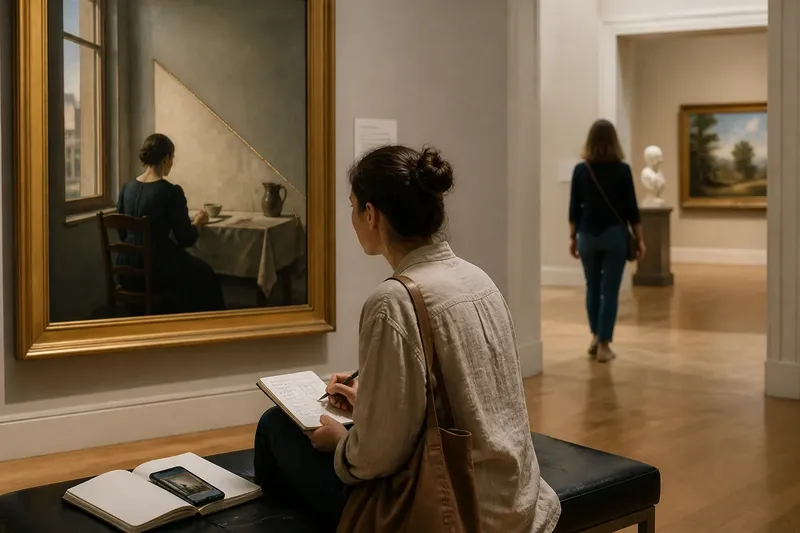
You enter a gallery, glance at a painting, and turn straight to its wall text. The gallery-label trap is treating that text as the authority on what the work means, rather than as a source of context you can consult and weigh.
A label can identify an artist, medium, subject, or historical setting. Those facts are useful, but they are not the artwork itself, and they do not settle every question about it. The task is not to avoid labels; it is to understand what kind of information they offer and how it relates to your own response.
Read a label as a source with a purpose
Gallery text often combines several kinds of information: identification, description, historical context, and interpretation. A title or medium may be straightforward catalog information, while a sentence about what a work suggests is an interpretive claim.
That distinction matters because not every sentence has the same status. “Oil on canvas” names materials; “the empty room evokes isolation” proposes a reading. You can accept the first as useful identification while treating the second as an idea to consider, not an instruction to feel isolated.
Labels are also selective. They make room for a few details, not every relevant influence, disagreement, or possible response. Their brevity can help you orient yourself, but it also means that a label is a frame rather than a complete account.
Use the text to answer a defined question
Instead of reading every line as a package, decide what you want the text to clarify. You might be trying to identify an unfamiliar material, understand a reference, or learn why a work is displayed alongside another piece.
That question gives you a way to evaluate the answer. If the label names a technique that helps explain a surface, it adds practical context. If it offers an interpretation that does not connect with what you notice, you can keep the interpretation in view without adopting it.
For example, imagine you see a small metal sculpture with a dark, uneven finish and wonder whether it was made from cast or assembled pieces. You read the label, which identifies welded steel but says little about the finish. You now know how the parts are joined, while the surface remains something the label has not explained.
Keep identification, context, and interpretation distinct
Identification tells you what the institution records: the artist, title, date, or medium. Context connects the work to circumstances, such as a commission, a place, a tradition, or a material process. Interpretation proposes what those details might mean.
These categories can overlap, but sorting them helps prevent a confident label sentence from becoming the only available reading. A note that an object was made for a particular room may explain its scale; a claim about how viewers should feel in that room is an interpretation you can assess for yourself.
When a label introduces a detail you cannot verify by looking, treat it as information about the work’s history rather than something visible in the object. When it describes a visible feature, you can check whether the description fits what is there. Either way, you remain free to ask what the detail contributes.
What should you do when the label raises questions?
Should you read the label before looking?
Read it first if you need access information or want a basic identifier before approaching the work. Otherwise, you can begin with the title and medium, then return to the interpretive text when you have a question it might answer.
What if you do not understand the artwork?
Use the label to identify a subject, material, or reference that is unfamiliar, then decide whether that information clarifies anything for you. If it does not, you can still respond to the work’s arrangement, surface, or mood without producing a complete explanation.
What if the label conflicts with your interpretation?
Check whether the disagreement is about a verifiable fact or a proposed meaning. Correct factual information can change what you know about the work; an interpretation can sit beside yours without replacing it.
Do you need to read every label?
No. Choose text that addresses a question you have, or read only the identification and context that help you orient yourself. You can leave other labels unread without missing a required part of the visit.
Choose what to do with each kind of information
A quick decision process can keep labels useful without turning them into a script. Check what the text is claiming, then decide whether to rely on it, consider it, or set it aside.
- Observation: The label gives a title or artist’s name. If you need to identify the work, use that information; then continue without assuming the title explains the whole piece.
- Observation: The label names a material you do not recognize. If the material could clarify the work’s surface or construction, keep the term in mind; otherwise, leave it as a fact to look up later.
- Observation: The text identifies a historical event or place. If that context changes how you understand a visible choice, consider the connection; if not, treat it as background rather than a required reading.
- Observation: The label says the work expresses a particular feeling. If you can see how its details support that interpretation, consider it; otherwise, keep your own response alongside it.
- Observation: A label describes a feature you cannot locate in the work. If the feature may be obscured by distance or display, look from another permitted viewing point; if it remains unclear, regard the description as a claim you cannot check visually.
- Observation: The text mentions a reference or tradition you do not know. If it matters to a question you have, note the name for later; otherwise, move on instead of turning the visit into an assignment.
Return to the work with a more precise question
Imagine you encounter a painting with a row of bright windows and read a label describing it as a portrait of a particular neighborhood. You had taken the windows as a decorative pattern. After reading, you look again to see whether their placement suggests a street or building; if it does, the context has sharpened your reading, and if it does not, the original pattern remains a valid part of your response.
This is a different task from trying to notice more details: you are checking what the label contributes, which parts are factual, and which parts are interpretation. The same approach works with a museum postcard, a catalog entry, or a saved image caption. Ask what the text tells you, what it leaves open, and whether it changes the question you want to bring back to the work.
The gallery-label trap loosens when you treat context as information to evaluate rather than permission to respond. A label can give you names, circumstances, and useful interpretations; your judgment determines which of those details help you understand the work, and which can remain in the margin.